
What are DevOps and CI/CD?
DevOps is a way of working in which the people who write software and the people who run it share one goal: getting changes to users quickly and safely. In practice it is a set of habits and tools that remove manual steps between a developer finishing a change and that change running in production. The name joins development and operations, the two groups that used to hand work over a wall to each other.
CI/CD is the engine of DevOps. CI means continuous integration: every time a developer saves a change to the shared code, an automated system builds the software and runs its tests, so problems are found within minutes. CD means continuous delivery or continuous deployment: once a change passes, the same system packages it and moves it through test environments to production, either at the press of a button or automatically. Together they form a pipeline.
Two more ideas complete the picture. Infrastructure as code means servers, networks and databases are described in files, kept in version control and created by a tool such as Terraform, not clicked together by hand. An environment can then be rebuilt identically in minutes, and every change to it is reviewed and recorded. Containers package an application with everything it needs so that it runs the same way on a laptop, a test server and production. Kubernetes is the most common system for running many containers reliably.
The last piece is observability: logs, metrics and traces collected in one place, with alerts that tell the right person when something is wrong. A pipeline lets you release quickly. Observability tells you whether the release was a good one, and lets you roll back before customers notice if it was not.
None of this is about tools for their own sake. Teams adopt DevOps because releasing by hand is slow, stressful and error-prone, and because a company that can ship a fix in an hour serves its customers better than one that needs a fortnight and a weekend. The research programme known as DORA measures this with four numbers, and we use the same four to show progress.
- A checklist run by one person
- Environments drift apart over time
- Releases happen at night or weekends
- Rollback means repeating the work
- The same automated steps every time
- Environments created from code
- Small releases during the working day
- Rollback is one command
It also changes how teams feel about releasing. When a release is small, automatic and easy to undo, it stops being an event that people dread and becomes an ordinary part of the working day.
How we deliver a DevOps engagement, step by step
No two companies start from the same place, so Organizein does not sell a standard DevOps package. Every engagement begins with an assessment and ends when your team can run what we built, or with our engineers running it for you. In between, work is split into steps that each deliver something usable on their own, so you can stop, pause or change order without losing what is already done.
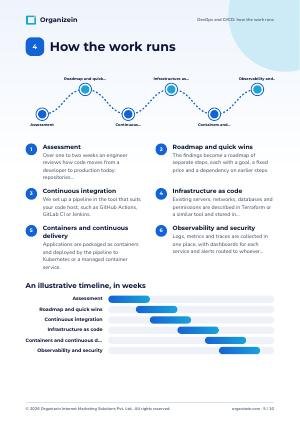
Assessment
Over one to two weeks an engineer reviews how code moves from a developer to production today: repositories, branching, builds, tests, environments, cloud accounts, access and costs. We interview developers and operations staff and record your current DORA metrics as a baseline. You receive a written report with findings in order of risk and effort.
Roadmap and quick wins
The findings become a roadmap of separate steps, each with a goal, a fixed price and a dependency on earlier steps. We normally start with one or two quick wins, such as automated builds or fixing a fragile deployment script, so that your team feels the benefit in the first fortnight.
Continuous integration
We set up a pipeline in the tool that suits your code host, such as GitHub Actions, GitLab CI or Jenkins. Every push triggers a build, automated tests and code-quality checks, and the result is reported in the pull request. Where tests are thin, we work with your developers or our QA team to add the most valuable ones first.
Infrastructure as code
Existing servers, networks, databases and permissions are described in Terraform or a similar tool and stored in version control. Development, staging and production are then created from the same definitions with different sizes. From this point, nobody changes infrastructure by hand, and every change has an author and a review.
Containers and continuous delivery
Applications are packaged as containers and deployed by the pipeline to Kubernetes or a managed container service. We choose a release method with you, for example blue-green or canary, so new versions take traffic gradually and can be rolled back in seconds. Database changes are scripted and run as part of the release.
Observability and security
Logs, metrics and traces are collected in one place, with dashboards for each service and alerts routed to whoever is on call. Secrets move into a vault. The pipeline gains scans for vulnerable dependencies, container images and infrastructure definitions. Backups are scheduled and a restore is tested.
Handover or managed operations
We document the setup, record walkthroughs and pair with your engineers until they are comfortable making changes themselves. If you prefer not to run it, our site reliability and monitoring team takes over daily operations under an agreed service level.
Who works on your platform
A typical engagement has a lead DevOps engineer and one or two engineers with the cloud and tooling skills your stack needs, supported by a security specialist when required. The lead is your single contact. The people who assess your setup are the people who then build it, so nothing is lost between report and delivery.
How we work alongside your developers
We join your chat channels and stand-ups and work in your repositories through pull requests, exactly as a colleague would. Changes to pipelines and infrastructure are reviewed by your team as well as ours. That is slower than working alone for the first weeks and much faster afterwards, because your developers understand what was built and why.
How we change live systems safely
Nothing is switched over in one step. New pipelines run beside old release methods until they have proved themselves. Infrastructure changes are applied to development, then staging, then production, with a written plan and a rollback path for each. Risky changes are scheduled for quiet hours agreed with you, and we stay online until monitoring confirms a normal state.
Access, ownership and cost control
Everything is built in your own cloud accounts and repositories. We work with named, least-privilege access that you can revoke at any time, and we sign a non-disclosure agreement before the assessment. Cloud spend is tagged by environment and service, and a monthly cost report shows where the money goes and what could be switched off.
How we deal with what is already there
Few clients start with a blank page. There are servers that nobody dares restart, scripts written by people who have left and settings changed by hand over the years. We do not replace these in one move. Each existing resource is first imported into code exactly as it is, so the description matches reality. Improvements then follow as small, reviewed changes, each of which can be undone.
How your developers' daily work changes
The aim is that a developer's routine becomes simpler, not more complicated. They open a pull request, the pipeline reports within minutes whether the change builds and passes, a preview environment lets a colleague try it, and merging releases it. We write a short guide for this workflow, run a session with the team and stay in the channel for questions during the first weeks.
How on-call and incidents are organised
Automation does not remove incidents, so we set up how they are handled. Alerts are routed to a rota, each alert links to a runbook that says what to check first, and every significant incident is followed by a short written review that looks for causes, not culprits. Actions from those reviews go back into the roadmap.
Weeks. An illustration of a typical order of work, not a quote.

What is included in our DevOps and CI/CD service
The roadmap prices each of these separately. You can take them in order or pick the ones that solve your immediate problem.
DevOps assessment
A written review of how you build, test, release and run software, with baseline metrics.
CI pipelines
Automated builds, tests and quality checks on every change.
CD pipelines
Repeatable releases to each environment with approvals and rollback.
Infrastructure as code
Cloud resources defined in Terraform or similar and kept in version control.
Containers and Kubernetes
Applications containerised and run on a managed cluster.
Monitoring and alerting
Dashboards, logs, traces and on-call alerts for every service.
Pipeline security
Secret management and scans of code, dependencies and images.
Cost review
Tagged spending, right-sizing and a monthly report of savings found.
Cloud usage and licences for paid tools are billed to you by the providers. We estimate these in the roadmap for each design, favour open-source tools where they are good enough, and add no margin to third-party costs.
Who uses this service, and why
Clients come to us for DevOps help at four typical moments. The symptoms differ, but the underlying need is the same: releases that do not depend on luck or on one person.
Teams that release by hand
Deployments take hours, happen out of hours and sometimes fail. You want them to be routine.
Companies moving to the cloud
You are leaving a data centre or a single server and want the new setup built properly from the start.
Products growing fast
Traffic and team size have outgrown the original hosting, and outages are becoming more frequent.
Firms facing an audit
A customer or regulator asks who can change production and how changes are approved, and you need evidence.
If you are still planning the move itself, our cloud migration service covers the assessment and transfer of workloads, and usually runs alongside this one.
Tools and platform choices
We work with the tools you already have where they are sound, and suggest changes only where they hold you back. The diagram shows the layers of a delivery platform, and the table shows how we choose between common options.
| Decision | When the simpler option is enough | When to choose the larger one |
|---|---|---|
| Kubernetes or a managed container service | A few services and a small team | Many services, several teams, complex scaling |
| One cloud or several | Almost always one | A customer or regulator requires it |
| Hosted or self-run pipeline tool | Standard builds and no special network needs | Strict isolation or unusual hardware |
| Blue-green or canary releases | Low traffic and simple rollbacks | High traffic where gradual exposure reduces risk |
Our default advice is to choose the simplest platform that meets your needs for the next two years. Kubernetes is powerful, but a small product on a managed container service is cheaper to run and easier to hand over.
What decides the cost and timeline
The assessment has a fixed price. Everything after it is priced step by step in the roadmap. These factors have the largest effect. The pricing page explains how fixed steps and monthly plans are billed.
- The number of applications and services, and how differently each is built and released.
- How much automated testing already exists. A pipeline can only run the tests you have.
- The state of the current infrastructure and how much of it is undocumented.
- Compliance needs such as audit trails, separation of duties and data residency.
- Whether we hand over to your team or continue to operate the platform.
- How many environments and regions you need.
Cloud bills are a separate matter from our fees. We estimate the running cost of each design before building it, and the cost review often pays for a good part of the engagement.
What we measure
We use the four DORA measures, plus two that matter to whoever pays the bills. A baseline is taken in the assessment and the same numbers are reported each month.
Deployment frequency
How often changes reach production.
Lead time for changes
The time from a developer's commit to that change running in production.
Change failure rate
The share of releases that cause an incident or need a rollback.
Time to restore service
How long it takes to recover when something does go wrong.
Pipeline duration
How long developers wait for a build and test run to finish.
Cloud cost per environment
Monthly spend by environment and service, with the trend.
Mistakes we see in DevOps work
Most of the platforms we are asked to repair were built with good tools and poor habits. These are the patterns we meet most often.
Buying tools before fixing the process
A new platform will not help if releases still wait a week for a manual sign-off.
Adopting Kubernetes too early
It adds real operating work. A small team with three services rarely needs it.
Changing infrastructure by hand
One manual fix in the console and the code no longer describes reality.
Pipelines without tests
Automation that ships untested code only delivers problems faster.
Alerts nobody trusts
If most alerts are noise, the important one is ignored. Fewer, better alerts work.
The first 90 days after handover
The real test of a delivery platform is whether your team uses it when we are not watching. In the first month after handover we stay close: we review pipeline failures with your developers, tune alerts that fire too often and fix any step that people are tempted to bypass. Small frictions matter here, because a pipeline that is slow or flaky is soon worked around.
In the second and third months we compare the four delivery measures with the baseline from the assessment and report the change. We also run a recovery drill, restoring a database from backup and rebuilding an environment from code, to prove that both work when needed. The period ends with a review of the roadmap, where remaining steps are re-ordered in the light of what the numbers show.
What to prepare, and what to ask any DevOps provider
An assessment goes faster and finds more when a few things are ready at the start. The first list is what we ask for. The second is what we suggest you ask any DevOps provider, including us.
What to prepare before the assessment
- A list of your applications, where each is hosted and who maintains it.
- Read-only access to repositories, pipelines and cloud accounts.
- A description of how the last release was done, step by step.
- Recent incidents and what caused them, if known.
- Your last three months of cloud bills.
- Any compliance standard you must meet or plan to meet.
Questions to ask any provider
- Will everything be built in our own accounts and repositories?
- How will you work with our developers day to day?
- How do you make changes to production safely, and what is the rollback plan?
- Which metrics will show that the work has made a difference?
- What will our team need to learn, and how will you train them?
- What will the platform cost to run each month once you are finished?
Terms used on this page
DevOps is full of abbreviations. These are the ones used in our assessments and roadmaps, in plain words.
- CI/CD
- Continuous integration and continuous delivery: automated building, testing and releasing of software.
- Pipeline
- The automated sequence of steps a code change passes through on its way to production.
- Infrastructure as code
- Describing servers and networks in files so they can be created and changed automatically.
- Container
- A package holding an application and everything it needs to run the same way anywhere.
- Kubernetes
- An open-source system for running and scaling containers across many machines.
- Canary release
- Sending a small share of traffic to a new version first to check it behaves.
Questions about DevOps and CI/CD
What does a DevOps engineer actually do?
They automate how software is built, tested, released and run: pipelines, infrastructure as code, containers, monitoring and the security around them.
How long does it take to set up CI/CD?
A basic pipeline for one application can be working within two weeks. A full platform with infrastructure as code and monitoring usually takes two to three months.
Do we need Kubernetes?
Not always. If you run a handful of services, a managed container service is simpler and cheaper. We recommend Kubernetes when scale or team structure calls for it.
Which cloud platforms do you work with?
AWS, Microsoft Azure and Google Cloud, as well as private data centres and hybrid setups.
Which CI/CD tools do you use?
GitHub Actions, GitLab CI, Jenkins, Azure DevOps and Argo CD are the most common. We normally keep the tool that matches your code host.
Will you need access to production?
Yes, limited to what each task requires, through named accounts you control and can revoke. All changes go through reviewed code where possible.
Can you work with our existing developers?
Yes. We work in your repositories and channels through pull requests, and your developers review what we build.
What is infrastructure as code?
It is the practice of defining servers, networks and databases in files, so environments are created by a tool, changes are reviewed and nothing depends on memory.
Can you reduce our cloud bill?
Often. We tag spending, remove unused resources, right-size servers and suggest reserved capacity. Savings are reported monthly so you can check them.
How do you make releases safer?
Smaller releases, automated tests, gradual rollout with blue-green or canary methods, and a rollback that takes seconds instead of hours.
Do you provide 24/7 monitoring?
Yes, through our site reliability and monitoring service, with an agreed response time and escalation path.
Can you help us pass a security audit?
Yes. We add access controls, audit trails, secret management and scanning, and document change approval so you can show evidence to an auditor.
What are DORA metrics?
Four measures of software delivery: deployment frequency, lead time for changes, change failure rate and time to restore service.
Can you migrate us from Jenkins to another tool?
Yes. We move jobs one at a time, run old and new side by side until results match, and then retire the old ones.
Do you handle database changes in the pipeline?
Yes. Schema changes are written as versioned scripts and applied automatically during a release, with a plan for reversing each one.
Do you sign an NDA?
Yes, before the assessment starts and before any access is granted.
Can we hire a DevOps engineer from you full time?
Yes. You can take a dedicated engineer or a small team on a monthly basis, working as part of your own staff.
What happens when the engagement ends?
You have documentation, recorded walkthroughs and a team trained to run the platform. We remain available for support or managed operations if you want it.
Is DevOps only for large companies?
No. Small teams gain the most from automation because they have the least time to spend on manual releases.
How do we get a quote?
Send the form on this page with a short note on your stack. We reply with questions, then a fixed price for the assessment.
A ten-page guide to DevOps and CI/CD
Further reading
Related services and reading
Guides
How Much Should a Website Cost?
Are you thinking of redesigning your already existing website or simply wish to launch a new one?
What Is CRM
Best Interaction services with Customers.
What Is Digital Marketing
Build Brand Recognition as an Industry Leader and Enhance Profitability
Further reading
Independent sources on the standards and platforms behind this work.